
Toys and baby supplies shop guide
A learning path for a toys and baby supplies shop, new or running: job titles, milk with batches, clothes per size, promotions, points, opening balances.
On this page
- A new business
- Who does what
- 1. Shop details and users
- 2. Master data
- 3. Starting capital, purchases and receiving goods
- 4. A day of selling
- 5. Payables, costs, promotions and expiry
- 6. Reports per job title
- 7. Checklists
- A running business
- 1. Master data
- 2. Practice for the team
- 3. Emptying the practice transactions
- 4. Opening balances
- 5. Check before going live
- 6. Going live
This guide is for the team setting up Vende at a toys and baby supplies shop that sells milk, baby food, baby clothes and toys to buyers who walk in. It has two parts: A new business for a shop just opening, with no stock, receivables or payables from before, and A running business for one moving to Vende, with team practice and opening balances. The example is Rumah Bayi Bunda. The names of the shop, customers, suppliers and people and all the figures are made up.
What the business looks like:
- Milk and baby food: bought from a distributor on 30 days' credit. Every tin and box has a batch number and an expiry date.
- Baby clothes and toys: clothes in several age sizes, toys per set, bought in full from a wholesaler.
- Selling: buyers come to the till, members collect points and get a free baby porridge with every two tins of milk.
- Store room: goods from the distributor are received in the store room without seeing the purchase prices, then labelled.
Work through it from the top. Every step names its menu, who does it, what changes afterwards, and an example with figures.
The features in this guide come with the Toys and baby supplies business type package, except those marked extra. The shop's features show under Settings → Subscription, section This shop's features. If a menu is missing, contact the Vende team.
Tip: Lost on a page? Press the ? button at the top of that page. A short tour shows every field, on the till too.
A new business
Who does what
This package holds three users, the owner included.
| Part of the shop | Job title in Vende | What they do and open |
|---|---|---|
| Owner | Owner | Every menu, also suppliers, purchase notes, promotions, points, banking the till cash, payments, opening balances, Reports → Cash Balance and Reports → Profit & Loss |
| Store room and shelves | Warehouse Admin | Products and variants, receiving goods with their batches, barcode labels, expired goods, stocktakes, Master Data → Batches and Reports → Stock |
| Cashier | Cashier | Selling at the till, size swaps from the original note, members, Transaction Details → Sale Lines |
Every role is explained in Roles and permissions.
1. Shop details and users
Done by the Owner: fill in Settings → Shop (name, address, WhatsApp, logo), then make the accounts in Settings → Users with the Job title from the table above. See Adding and managing users.
The people at Rumah Bayi Bunda: Bu Anita (owner), Mas Doni (store room and shelves, Warehouse Admin) and Mbak Lusi (cashier, Cashier).
2. Master data
A shop of this business type already has the product categories Toys, Baby Clothes, Baby Milk and Food, Baby Supplies, and Strollers and Carriers, the units Box, Set and Can besides Pcs, and the expense category Shopping Bags.
Products
Warehouse Admin: in Master Data → Products, make every product:
| Product | Category | Base Unit | Selling Price | Tracking |
|---|---|---|---|---|
| Susu Formula Bayi 0-6 Bulan 400 g | Baby Milk and Food | Can | Rp 115.000 | Track batches & expiry |
| Bubur Bayi Instan 120 g | Baby Milk and Food | Box | Rp 22.000 | Track batches & expiry |
| Baju Bayi Jumper | Baby Clothes | Pcs | Rp 55.000 | None |
| Balok Susun Kayu | Toys | Set | Rp 99.000 | None |
The Warehouse Admin does not see Cost Price, because the cost of goods shows only to the Owner and holders of Sensitive Reports. Leave it: the Owner's purchase notes in part 3 fill in their cost, for example Rp 95.000 for the milk. See Cost price of goods.
Baju Bayi Jumper has variants: in the Variants section, switch on Has variants (size, colour and more), fill in the Option name Size with the values 0-3 bulan, 3-6 bulan and 6-12 bulan, then press Make variant combinations and Fill in empty codes. See Product variants and Batches and expiry dates.
Suppliers, members, points and a promotion
- Owner: in Master Data → Suppliers, list CV Nutrisi Bunda with Payment Terms (days) 30, and Grosir Mainan Ceria.
- Cashier: in Master Data → Customers, list the first member, Bu Yanti, with her WhatsApp number.
- Owner: in Settings → Points, switch on Enable customer points, fill in Spending per point 10.000 and Value of 1 point 100. See Giving and redeeming customer points.
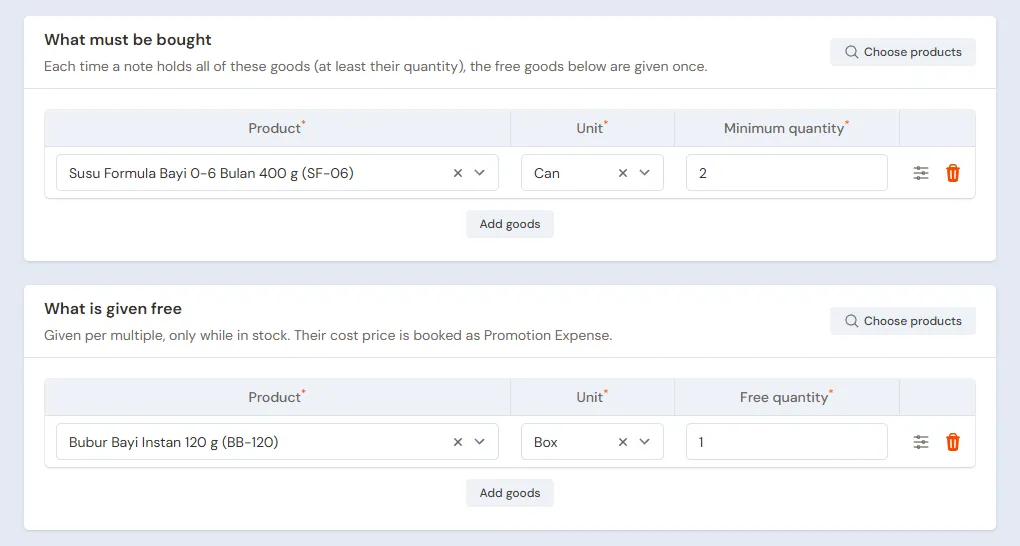
- Owner: in Master Data → Promotions, make the promotion "Buy 2 milk get 1 porridge free": under What must be bought 2 Susu Formula Bayi 0-6 Bulan 400 g, under What is given free 1 Bubur Bayi Instan 120 g. Fill in Multiples per note 2 when one note gets at most 2 free porridges, then switch on Active. See Automatic promotions.
- Owner: in Settings → Alerts, fill in About to Expire 60.
3. Starting capital, purchases and receiving goods
- The Owner records capital of Rp 10.000.000 into Bank BCA in Transactions → Finance → Owner's Capital, then moves Rp 300.000 to Cashier Cash as change money in Transactions → Finance → Cash Transfers.
- The Owner records the invoice of CV Nutrisi Bunda in Transactions → Purchases, without a payment: 12 Cans of Susu Formula Bayi 0-6 Bulan 400 g × Rp 95.000 = Rp 1.140.000 and 24 Boxes of Bubur Bayi Instan 120 g × Rp 15.000 = Rp 360.000, so Rp 1.500.000. Switch off All goods have been received, because the goods are received in the store room.
- The Warehouse Admin (Mas Doni) opens Transactions → Receive Goods, presses Receive on that invoice, and fills in the quantities that came and their batches: the milk batch SF2610 expiring 10/2027, the porridge batch BB2609 expiring 03/2027. Press Save Receipt. This screen shows no purchase prices.
- The Owner records the note of Grosir Mainan Ceria, paid in full from Bank BCA: 6 pcs of every size of Baju Bayi Jumper (18 × Rp 30.000 = Rp 540.000) and 4 Sets of Balok Susun Kayu (Rp 240.000), so Rp 780.000.
- The Warehouse Admin prints the labels in Master Data → Print Labels: Source Purchase note and Number of labels By quantity (unit on the document). Choose the CV Nutrisi Bunda invoice under Document and press Take Goods, then choose the Grosir Mainan Ceria note and press Take Goods again. 58 labels come out. See Printing price labels and barcodes.
See Recording a purchase note and Receiving goods that arrive in parts.
4. A day of selling
| Time | Who | Work |
|---|---|---|
| 09.00 | Cashier | Opens the till |
| All day | Cashier | Sells to walk-in buyers and members |
| Afternoon | Cashier | A clothes size swap |
| Closing | Owner | Banks the till cash |
Selling at the till
Open the till with New sale on the Dashboard, then scan the barcode label. Milk and porridge always come from the batch closest to expiry first.
- Cashier (Mbak Lusi): a walk-in buyer buys Baju Bayi Jumper - 3-6 bulan (Rp 55.000) and Balok Susun Kayu (Rp 99.000), so Rp 154.000 in cash.
- Cashier: Bu Yanti buys 2 Cans of Susu Formula Bayi 0-6 Bulan 400 g, Rp 230.000. Choose Bu Yanti under Customer. On saving, the promotion adds 1 free Bubur Bayi Instan 120 g under Promotions. She pays by transfer into Bank BCA and earns 23 points.
See Recording sales on the till.
A clothes size swap
Cashier: the first buyer comes back because the romper is too small. Press Add return, choose the note on the tab From the original note, tap Baju Bayi Jumper - 3-6 bulan, then press Done. Scan Baju Bayi Jumper - 6-12 bulan. The price is the same, so there is Rp 0 to pay. Press Pay, then Save transaction. See Recording a sales return.
Closing and banking the till cash
The Owner (Bu Anita) counts the drawer: Rp 300.000 change money + Rp 154.000 = Rp 454.000. The Rp 154.000 is moved to Owner Cash in Transactions → Finance → Cash Transfers. A drawer holding less or more than counted is recorded in Transactions → Finance → Cash Adjustments. See Moving money between cash accounts.
5. Payables, costs, promotions and expiry
- The Owner pays CV Nutrisi Bunda before the due date in Transaction Details → Purchase Payments: Rp 1.500.000. See Paying what you owe suppliers.
- The Owner records rent, electricity, salaries and shopping bags in Transactions → Finance → Expenses. See Recording shop expenses.
- The Warehouse Admin takes milk or porridge past its date out in Transactions → Stock Adjustments with Direction Out and Category Expired. See Stock adjustments.
The free porridge of the promotion is not sold: its cost, Rp 15.000, is recorded as Promotion Expense. Bu Yanti's points are recorded when the note is saved: 23 points × Rp 100 = Rp 2.300 as Points Expense, and the same Points Liability until the points are redeemed.
A customer who pays later, for example an office ordering gifts, is recorded with Unpaid and the Owner records the payment in Transaction Details → Sale Payments. See Recording payments of unpaid notes.
6. Reports per job title
| Report | What it holds | Opened by | When |
|---|---|---|---|
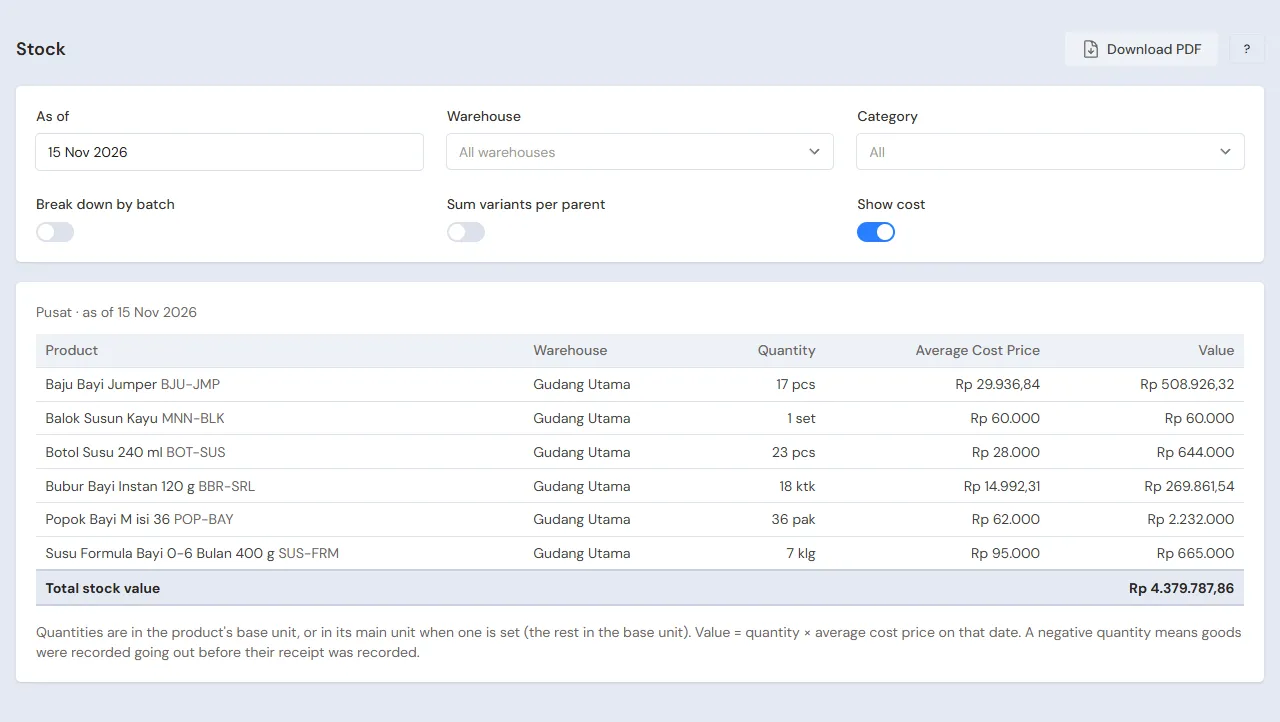
| Reports → Stock | The stock of every product and size; switch on Break down by batch for what is left of every milk batch | Warehouse Admin | Every day |
| Master Data → Batches | Every batch, its expiry and what is left | Warehouse Admin | Every week |
| Transaction Details → Sale Lines | The goods sold and the Returns tab for size swaps | Cashier | Every day |
| Reports → Cash Balance | The drawer, Owner Cash and the bank | Owner | Every day |
| Reports → Payables | What is owed to the distributor and when | Owner | Every week |
| Reports → Profit & Loss | Sales, cost of goods sold, expenses, Promotion Expense and Points Expense | Owner | Every month |
7. Checklists
- Every day: the Cashier scans the labels. The Owner counts the drawer and banks the money.
- Every week: the Warehouse Admin reads the expiry alerts and moves those batches to the front of the shelf. The Owner pays the distributor when due.
- Every month: the Warehouse Admin takes expired goods out and counts the stock with a stocktake. The Owner reads Profit & Loss. See Counting stock with a stocktake.
A running business
This part is for the team moving a running shop to Vende: milk from several batches, clothes in several sizes, toys on the shelves, payables to the distributor, and members who already have points. The order is always the same:
- Enter the master data.
- Practise transactions until every part is used to them.
- Empty the practice transactions.
- Enter the opening balances on the first day.
- Go live.
The opening balances come last on purpose, so the practice does not spoil their figures. The examples in this part use Rumah Bayi Bunda from the new business part.
1. Master data
Work through the parts Who does what, 1. Shop details and users and 2. Master data above. Also list every product and size still in stock, every distributor still owed, and every member with points. The master data is not deleted when the practice transactions are emptied.
2. Practice for the team
Work in a practice shop of the Toys and baby supplies type with the three accounts. Every step names who does it and what must show.
Practice 1: master data
- Owner: the shop details, the two users, both suppliers, the points, the promotion and the alert.
- Check: Mbak Lusi sees no purchase menus and no money reports.
- Warehouse Admin: the four products with batches and the three romper sizes.
- Cashier: Bu Yanti.
Practice 2: a day of selling
- Owner: capital of Rp 10.000.000, the transfer of Rp 300.000 to Cashier Cash, and both purchase notes as in part 3.
- Warehouse Admin: receive the goods of the CV Nutrisi Bunda invoice with both batches, then print the 58 labels.
- Check: in Transactions → Receive Goods, that invoice shows no prices, and once received it no longer shows. Opened by the Warehouse Admin.
- Mbak Lusi (Cashier): both sales and the size swap as in part 4.
- Check: on Bu Yanti's note, the Promotions part holds 1 Bubur Bayi Instan 120 g.
- Owner: the transfer of Rp 154.000 from Cashier Cash to Owner Cash.
After Practice 2 this must show:
| Report | What must show | Opened by |
|---|---|---|
| Reports → Cash Balance | Cashier Cash Rp 300.000; Owner Cash Rp 154.000; Bank BCA Rp 10.000.000 − Rp 300.000 − Rp 780.000 + Rp 230.000 = Rp 9.150.000 | Owner |
| Reports → Payables | CV Nutrisi Bunda Rp 1.500.000 | Owner |
| Reports → Stock | Susu Formula 10 cans, Bubur Bayi Instan 23 boxes, Baju Bayi Jumper 17 pcs (3-6 bulan 6, 6-12 bulan 5), Balok Susun Kayu 3 sets | Warehouse Admin |
| Reports → Profit & Loss | Net sales Rp 154.000 + Rp 230.000 = Rp 384.000, cost of goods sold Rp 30.000 + Rp 60.000 + Rp 190.000 = Rp 280.000, Promotion Expense Rp 15.000, Points Expense Rp 2.300 | Owner |
The size swap changes neither sales nor cost, because both sizes have the same price and cost.
Practice 3: opening balances
Enter the opening balances with the example of part 4 below, check them as in part 5, then empty them again.
3. Emptying the practice transactions
Done by the Owner in Settings → Empty Transactions, button Empty All Transactions. Sale and return notes, purchases and their goods receipts, batches, stock adjustments, the points history and point adjustments, payments, cash transfers, capital, expenses and opening balances are deleted. Products with their variants, promotions, customers, suppliers, cash accounts, users and settings stay. Vende makes a full backup first. See Emptying transactions or all data.
4. Opening balances
Done by the Owner in Settings → Opening Balances on the morning of the first day, with As of that day, before the shop opens. See Entering opening cash, stock, receivables and payables.
- Opening Stock: milk and porridge one row per batch with its Batch number and Expiry, for example Susu Formula Bayi 0-6 Bulan 400 g 5 Cans batch SF2605 expiring 05/2027 at Rp 95.000. Clothes one row per size, for example Baju Bayi Jumper - 0-3 bulan 4 Pcs at Rp 30.000. The Warehouse Admin's count gives the quantities.
- Opening Payables: CV Nutrisi Bunda Rp 950.000.
- Opening Cash: the money counted in every account, for example Cashier Cash Rp 300.000 and Bank BCA Rp 6.000.000.
Members' points from before
Opening Balances has no points tab. The Owner makes the category Poin awal in Master Data → Point Adjustment Categories, then records every member's points in Transactions → Point Adjustments: Bu Yanti, Category Poin awal, Add, Points 150.
A point adjustment changes no cash, but like points earned on a purchase, its value is recorded as Points Expense and Points Liability: 150 × Rp 100 = Rp 15.000 in Profit & Loss of the first month.
5. Check before going live
| Report | What must show | Opened by |
|---|---|---|
| Reports → Cash Balance | The money counted in every account | Owner |
| Master Data → Batches | SF2605 5 cans with its expiry | Warehouse Admin |
| Reports → Stock | The count of every product and size | Warehouse Admin |
| Reports → Payables | CV Nutrisi Bunda Rp 950.000 | Owner |
| Master Data → Customers | The Points column: Bu Yanti 150 | Cashier |
The figures differ? The Owner corrects the row in Settings → Opening Balances before any real transaction is recorded.
6. Going live
From that day every sale, size swap, purchase, goods receipt and payment is recorded in Vende as in the new business part, with the same checklist. In the first week the Warehouse Admin labels goods without a label and matches Reports → Stock with the shelves, and the Owner checks that Reports → Profit & Loss only holds sales and costs since the first day.