
Musical instrument shop guide
A learning path for a musical instrument shop, new or running: job titles, serial numbers, labelled strings, set-ups, lessons, instalments, opening balances.
On this page
- A new business
- Who does what
- 1. Shop details and users
- 2. Master data
- 3. First capital and buying
- 4. Selling instruments, strings and lessons
- 5. One repair from drop-off to pickup
- 6. Payables and expenses
- 7. Reports per job title
- 8. Checklists
- A running business
- 1. Master data
- 2. Team practice
- 3. Empty the practice transactions
- 4. Opening balances
- 5. Check before going live
- 6. Going live
This guide is for the team setting up Vende at a musical instrument shop that sells guitars, keyboards and other instruments with a serial number, strings and accessories, takes in repairs and set-ups, and runs music lessons. It has two parts: A new business for a shop just opening, with no stock, receivables or payables from before, and A running business for a shop moving to Vende, with team practice and opening balances. The example is Toko Musik Nada Prima. The names of the shop, customers, suppliers, people and brands and all the figures are made up.
What the business looks like:
- Instruments: acoustic guitars in two colours and keyboards, every instrument known by its serial number, from bought to sold.
- Strings and accessories: guitar strings by the set and drumsticks by the pair, with barcode labels.
- Repairs and lessons: customers' guitars are set up and restrung with a work order, and guitar lessons are sold as a service.
- Buyers: walk-in buyers paying cash or by transfer, a music studio with its own prices, and a keyboard buyer paying in instalments.
Work through it from the top. Every step names its menu, who does it, what changes afterwards, and an example with figures.
The features in this guide come with the Musical instrument shop business type package, except those marked extra. The shop's features show under Settings → Subscription, section This shop's features. If a menu is missing, contact the Vende team.
Tip: Lost on a page? Press the ? button at the top of that page. A short tour shows every field, on the Workshop Board too.
A new business
Who does what
This package holds four users, the owner included.
| Part of the shop | Job title in Vende | What they do and open |
|---|---|---|
| Owner | Owner | Every menu, also suppliers and purchase notes, customer payments and instalments, expenses, opening balances, and Reports → Profit & Loss |
| Cashier and repair desk | Head Cashier | Customers, groups and Special Prices, promotions, selling on the till, work orders, service staff |
| Repair and set-up technician | Technician | Work Orders and the Workshop Board: the status of every repair |
| Warehouse | Warehouse Admin | Products, services, service packages, barcode labels, serial numbers, Reports → Stock |
Lesson teachers need no account. Their names are registered as service staff and picked by the cashier on the lesson line. A bigger shop adds a Cashier or a Finance Admin by adding users to its subscription. Every role is explained in Roles and permissions.
1. Shop details and users
Done by the Owner: fill in Settings → Shop (name, address, WhatsApp, logo), then create the accounts in Settings → Users with the Job title of the table above. See Adding and managing users.
The people at Toko Musik Nada Prima: Pak Andre (owner), Mbak Lia (cashier and repair desk, Head Cashier), Mas Yoga (technician, Technician), Mas Bayu (warehouse, Warehouse Admin) and Pak Hendro (guitar teacher, no account).
2. Master data
A shop of this business type already has the product categories Guitars and Basses, Keyboards and Pianos, Drums and Percussion, Wind Instruments, Sound Systems and Audio, Accessories and Strings, Repair Services and Music Lessons, the units Unit, Set and Pair, and the expense categories Shopping Bags and Equipment Maintenance beside the common ones, such as Electricity, Rent and Salaries.
Instruments with a serial number
Warehouse Admin: in Master Data → Products, create every instrument and switch on Track serial numbers under Tracking before the goods are bought:
| Good | Category | Base Unit | First cost price | Selling Price |
|---|---|---|---|---|
| Gitar Akustik Melodia A10 (acoustic guitar) | Guitars and Basses | Unit | Rp 1.200.000 | Rp 1.500.000 |
| Keyboard Melodia K61 | Keyboards and Pianos | Unit | Rp 2.800.000 | Rp 3.500.000 |
Gitar Akustik Melodia A10 is made with variants: under Variants, switch on Has variants (size, colour and more), enter the Option name Warna (colour) with the values Natural and Hitam, then press Make variant combinations. Every colour has its own stock and uses serial numbers too. See Product variants and Serial numbers and IMEI.
Strings and accessories
Warehouse Admin: create Senar Gitar Akustik 012 (acoustic guitar strings; Accessories and Strings, Set, cost Rp 60.000, selling Rp 90.000) and Stik Drum 5A (drumsticks; Drums and Percussion, Pair, cost Rp 50.000, selling Rp 80.000), without serial numbers.
Services, lessons and service packages
Warehouse Admin:
- In Master Data → Services, create Setel Gitar (guitar set-up) Rp 75.000 and Ganti Senar (restringing) Rp 25.000 in the category Repair Services, and Kursus Gitar Dasar 4 Pertemuan (four beginner guitar lessons) Rp 400.000 in the category Music Lessons. See Adding a service.
- In Master Data → Service Packages, create the package Setel dan Ganti Senar Akustik holding the service Setel Gitar 1, the service Ganti Senar 1 and Senar Gitar Akustik 012 1. A package fills the work order's lines at once.
Service staff, customers and suppliers
- Head Cashier: in Master Data → Service Staff, register Mas Yoga and pick his account in Linked User. His name is chosen in the Mechanic field of a work order, and the work orders with his name show on Mas Yoga's Workshop Board. Without a Linked User, Mas Yoga's Workshop Board stays empty. Register Pak Hendro too, without a Linked User, for the lesson lines.
- Head Cashier: in Master Data → Customer Groups, create the group Sekolah Musik (music schools), then in Master Data → Special Prices give that group a Fixed price of Rp 80.000 for Senar Gitar Akustik 012. See Special Prices for customers and groups.
- Head Cashier: in Master Data → Customers, list Sanggar Musik Irama with Group Sekolah Musik, and Bu Ratna with Payment Terms (days) 30 for the keyboard she pays in stages.
- Head Cashier: a promotion, for example buy 2 Stik Drum 5A and get 1 free, is made in Master Data → Promotions. Serial-numbered goods, such as guitars and keyboards, cannot be used in a promotion. See Giving discounts and free goods.
- Owner: in Master Data → Suppliers, register CV Melodia Musik Indonesia (30 days' credit) and Grosir Aksesori Musik Harmoni.
3. First capital and buying
- The Owner records Rp 50.000.000 of capital into Bank BCA in Transactions → Finance → Owner's Capital.
- The Owner records the note of CV Melodia Musik Indonesia in Transactions → Purchases, 30 days' credit: 3 Gitar Akustik Melodia A10 - Natural and 3 - Hitam × Rp 1.200.000 (Rp 7.200.000), and 2 Keyboard Melodia K61 × Rp 2.800.000 (Rp 5.600.000), so Rp 12.800.000. In the details of every line, fill in Serial numbers one per line, scanned from the box or the label on the instrument's body.
- The Owner records the note of Grosir Aksesori Musik Harmoni, paid in full from Bank BCA: 24 Sets of Senar Gitar Akustik 012 (Rp 1.440.000) and 10 Pairs of Stik Drum 5A (Rp 500.000), so Rp 1.940.000.
- The Warehouse Admin prints the labels of the strings and drumsticks in Master Data → Print Labels, Source Purchase note, Number of labels by quantity. See Printing price labels and barcodes.
See Recording a purchase note and Recording serial numbers when buying.
4. Selling instruments, strings and lessons
The Head Cashier serves buyers on the till through Transactions → Sales, button New sale. Every guitar and keyboard is scanned by its serial number, and the number prints on the receipt. An example day:
| Buyer | Goods or service | Paid | Amount |
|---|---|---|---|
| Pak Doni | Gitar Akustik Melodia A10 - Natural | Transfer into Bank BCA | Rp 1.500.000 |
| Walk-in buyer | 2 Sets of Senar Gitar Akustik 012 × Rp 90.000 and 1 Pair of Stik Drum 5A Rp 80.000 | Cash | Rp 260.000 |
| Sanggar Musik Irama | 5 Sets of Senar Gitar Akustik 012 × Rp 80.000 (Special Price) | Transfer into Bank BCA | Rp 400.000 |
| Dimas | Kursus Gitar Dasar 4 Pertemuan, Performed by Pak Hendro | Cash | Rp 400.000 |
| Bu Ratna | Keyboard Melodia K61 | Rp 1.500.000 by transfer into Bank BCA, the rest owed | Rp 3.500.000 |
Services are in the item list like any item, marked Service. On the lesson line, pick Performed by Pak Hendro. In Transaction Details → Sale Lines, filter the Product Kursus Gitar Dasar 4 Pertemuan and show the Service Staff column to see every teacher's students before their fee is paid. See Recording sales on the till.
An instrument sent by the distributor before its note is recorded can still be sold: scan its serial number, then press Sell first, serial to follow. The instrument is matched by itself once its purchase is recorded. See Serial numbers and IMEI.
A keyboard paid in stages
Bu Ratna pays Rp 1.500.000 now and the rest in two instalments.
- Head Cashier: scan the keyboard and choose Bu Ratna under Customer. Press Pay, type Rp 1.500.000 with the method transfer into Bank BCA. The rest, Rp 2.000.000, shows under Becomes receivable. Press Save transaction. The receivable falls due in 30 days, Bu Ratna's payment terms.
- Owner: every time Bu Ratna pays an instalment, record it in Transaction Details → Sale Payments: choose Bu Ratna, Bank BCA, the Amount Rp 1.000.000, then Create. After the second instalment the note is paid. See Recording payments of unpaid notes.
The keyboard is Sold from the moment the note is saved, so its warranty can be checked by its serial number even before it is paid off. A walk-in buyer has to pay in full; a receivable is always in a customer's name. See Taking payment on the till.
5. One repair from drop-off to pickup
Example: Mas Fajar brings in his acoustic guitar, which is out of tune with rusty strings.
- Head Cashier: in Transactions → Work Orders, press New Work Order. Choose Mas Fajar, fill in a new unit: the Plate / Serial No. his guitar's serial number, the Unit Type Gitar, the Brand / Model Melodia A10. Enter the Complaint Fals dan senar karatan (out of tune, rusty strings), the Mechanic Mas Yoga and the Warranty (days) 14.
- In Service package, choose Setel dan Ganti Senar Akustik, then press Add: Setel Gitar Rp 75.000, Ganti Senar Rp 25.000 and the strings Rp 90.000, a total of Rp 190.000.
- Enter a Down payment amount of Rp 50.000 in cash, then save. Press Send Estimate (WhatsApp) so Mas Fajar gets the details.
- Technician (Mas Yoga): in Transactions → Workshop Board, tap the card of that work order and move it to In progress. While waiting for a part, move it to Waiting for parts.
- Head Cashier: once the guitar is done, press Done & Bill on the work order. The draft note opens on the till with Taken from the order down payment Rp 50.000. Mas Fajar pays Rp 140.000 in cash, then press Save transaction.
- Head Cashier: when the guitar is handed over, press Picked Up.
The strings leave the stock when the note is saved. The 14-day warranty counts from the day the repair is done and prints on its note. Mas Fajar's guitar is kept as his service unit, so the next repair only picks that unit.
6. Payables and expenses
- The Owner pays CV Melodia Musik Indonesia before the due date in Transaction Details → Purchase Payments: Rp 12.800.000 from Bank BCA. See Paying what you owe suppliers.
- The Owner records the shop rent, electricity, Pak Hendro's fee in the category Salaries, and the upkeep of the repair tools in Transactions → Finance → Expenses. See Recording shop expenses.
7. Reports per job title
| Report | What it shows | Opened by | When |
|---|---|---|---|
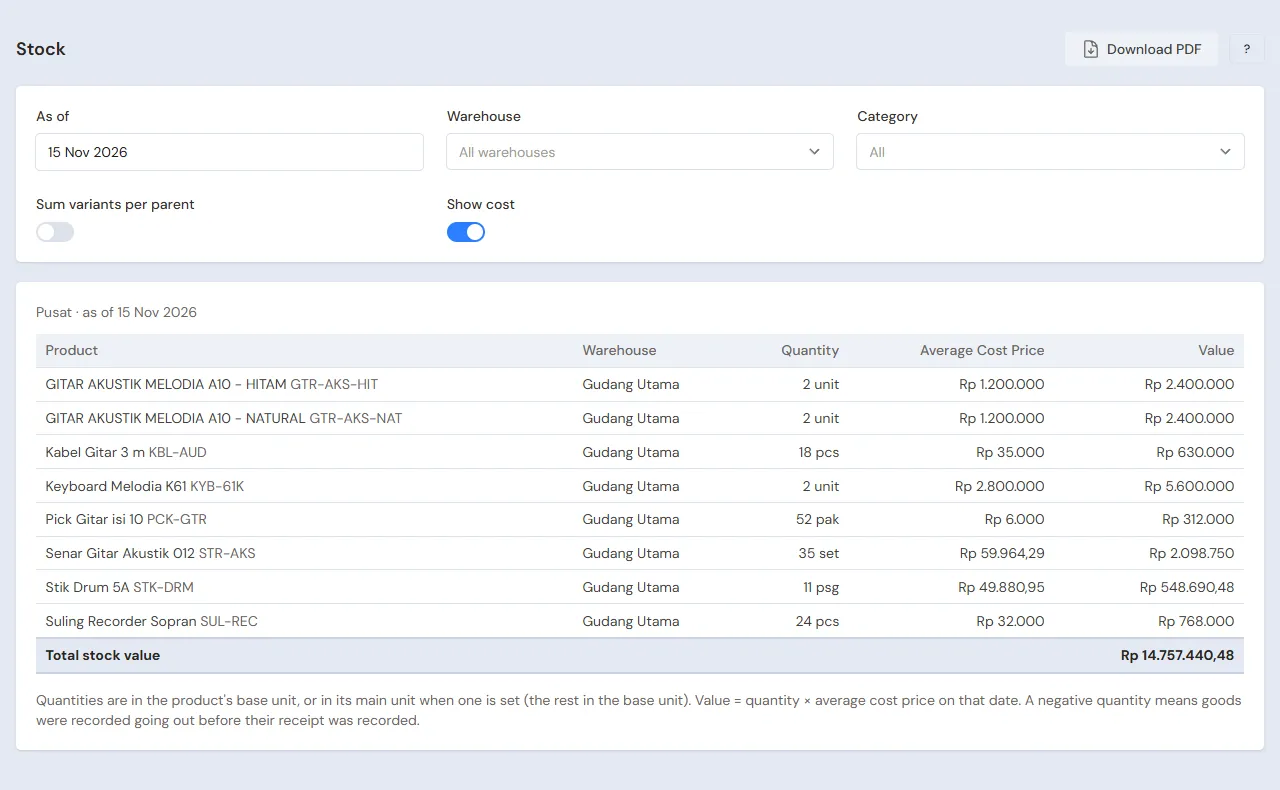
| Reports → Stock | Instruments per colour, strings and accessories | Warehouse Admin | Every day |
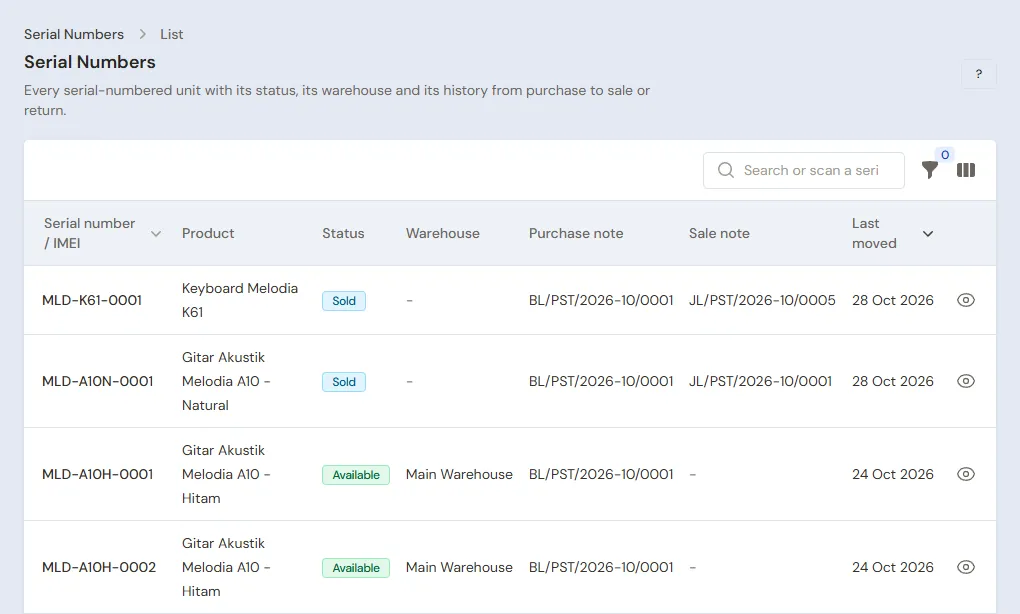
| Master Data → Serial Numbers | The status of every instrument and its history, for warranty claims | Warehouse Admin | When a claim comes |
| Transactions → Workshop Board | The customers' instruments still at the shop by status | Technician | Every day |
| Reports → Receivables | What every buyer still owes in instalments, with due dates | Owner | Every week |
| Reports → Payables | What is owed to distributors, with due dates | Owner | Every week |
| Reports → Profit & Loss | Sales of instruments and strings, repairs and lessons, cost of goods sold and expenses | Owner | Every month |
8. Checklists
- Every day: the Head Cashier scans every instrument sold, picks the teacher on every lesson line, and closes the work orders picked up. The Technician keeps the status on the Workshop Board up to date.
- Every week: the Owner collects the instalments due from Reports → Receivables, checks the dashboard card Goods sold, serial/stock not entered yet and records their purchases, then reads Payables.
- Every month: the Warehouse Admin counts the instruments, strings and accessories with a stocktake. The Owner reads Profit & Loss.
A running business
This part is for the team moving a musical instrument shop already running to Vende: there are already serial-numbered guitars and keyboards in the display case, strings and accessories, customers' instruments being set up, a keyboard its buyer is still paying off, students who paid for this month's lessons, and debts to distributors. The order is always the same:
- Fill in the master data.
- Practise transactions until every part is used to them.
- Empty the practice transactions.
- Fill in the opening balances on the first day.
- Go live.
The opening balances come last on purpose, so the practice does not upset their figures. The examples in this part use Toko Musik Nada Prima from the new business part.
1. Master data
Do Who does what, 1. Shop details and users and 2. Master data above. Also register every customer whose instrument is being repaired or who is still paying instalments, every supplier still owed, and every good still in stock, with Track serial numbers already on. That choice cannot change any more once its stock has moved.
Master data is not deleted when the practice transactions are emptied. The service units of practice customers stay too; delete those that are not real customers.
2. Team practice
Work in a practice shop of the type Musical instrument shop with all four accounts. Every step names who and what must show.
Practice 1: master data
- Owner: shop details, the three users and both suppliers.
- Check: Mas Yoga sees only Work Orders and the Workshop Board.
- Mas Bayu (Warehouse Admin): the four goods with colour variants and serial numbers, the three services and the package Setel dan Ganti Senar Akustik.
- Head Cashier: Mas Yoga and Pak Hendro as service staff, the group Sekolah Musik with the Special Price of the strings, Sanggar Musik Irama, Bu Ratna and Mas Fajar.
Practice 2: one working day, one instalment and one repair
- Owner: Rp 50.000.000 of capital and both purchase notes as in part 3, with six guitar serial numbers and two keyboard serial numbers.
- Check: in Master Data → Serial Numbers, Mas Bayu sees 8 instruments Available.
- Head Cashier: the sales as in part 4, also Bu Ratna's keyboard with Rp 1.500.000 paid.
- Owner: Bu Ratna's first instalment of Rp 1.000.000 into Bank BCA.
- Mbak Lia and Mas Yoga: Mas Fajar's repair as in part 5, up to Picked Up.
- Check: the Workshop Board is empty again, and its sale note is Rp 190.000 with a Rp 50.000 down payment.
After Practice 2 this must show:
| Report | What must show | Opened by |
|---|---|---|
| Reports → Cash Balance | Bank BCA Rp 50.000.000 − Rp 1.940.000 + Rp 1.500.000 + Rp 400.000 + Rp 1.500.000 + Rp 1.000.000 = Rp 52.460.000; Cashier Cash Rp 260.000 + Rp 400.000 + Rp 50.000 + Rp 140.000 = Rp 850.000 | Owner |
| Reports → Receivables | Bu Ratna Rp 3.500.000 − Rp 1.500.000 − Rp 1.000.000 = Rp 1.000.000 | Owner |
| Reports → Payables | CV Melodia Musik Indonesia Rp 12.800.000 | Owner |
| Reports → Stock | Guitars Natural 2 and Hitam 3, keyboard 1, strings 24 − 2 − 5 − 1 = 16, drumsticks 9 | Warehouse Admin |
| Reports → Profit & Loss | Sales of Goods Rp 1.500.000 + Rp 260.000 + Rp 400.000 + Rp 3.500.000 + Rp 90.000 = Rp 5.750.000; Service Revenue Rp 400.000 + Rp 75.000 + Rp 25.000 = Rp 500.000; Net sales Rp 6.250.000; Cost of Goods Sold Rp 1.200.000 + Rp 2.800.000 + 8 × Rp 60.000 + Rp 50.000 = Rp 4.530.000 | Owner |
Bu Ratna's keyboard goes into Sales of Goods at its full price on the day of its note, though it is only partly paid. Her instalments only move the receivable into the bank.
Practice 3: opening balances
Fill in the opening balances with the example of part 4 below, check them as in part 5, then empty again.
3. Empty the practice transactions
Done by the Owner in Settings → Empty Transactions, button Empty All Transactions. Notes, work orders with their down payments, purchases, the serial numbers recorded, payments and instalments, expenses, capital and opening balances are deleted. Products with their variants, services, service packages, service staff, Special Prices, promotions, customers with their service units, suppliers, cash accounts, users and settings stay. Vende makes a full backup first. See Emptying transactions or all data.
4. Opening balances
Done by the Owner in Settings → Opening Balances on the morning of the first day, with As of that day. See Entering opening cash, stock, receivables and payables.
- Opening Stock: every serial-numbered instrument asks for Serial numbers, one per line, as many as its quantity. Example: Gitar Akustik Melodia A10 - Natural 2 Units at Rp 1.200.000 with their two serial numbers, - Hitam 1 Unit with its serial number, Keyboard Melodia K61 1 Unit at Rp 2.800.000 with its serial number, Senar Gitar Akustik 012 30 Sets at Rp 60.000, Stik Drum 5A 12 Pairs at Rp 50.000. Scan the serial number from the box or the instrument's label so nothing is mistyped.
- Opening Payables: CV Melodia Musik Indonesia Rp 6.000.000 with its due date.
- Opening Receivables: what every buyer still owes in instalments. Example: Bu Ratna still owes Rp 1.000.000 for the keyboard she bought last month, with the due date of her next instalment. That instalment is recorded later by the Owner in Transaction Details → Sale Payments, as in the new business part.
- Opening Cash: the money counted in every account, less the repair down payment below. Example: the Bank BCA account Rp 20.000.000, the cashier's drawer Rp 600.000.
Instruments sold before the first day are not recorded in Vende. Their warranty claims are checked against the old notes. Lessons paid for before the first day are not recorded either: the money is already in what was counted, and the income belongs to the months before Vende. The next lesson payments are sold on the till as in part 4.
Customers' instruments being repaired
Opening Balances has no tab for repairs under way. The way to do it with what is there:
- The Head Cashier makes a work order on the first day for every instrument still at the shop, with the complaint, the mechanic, and the agreed services and strings, as in part 5.
- The down payment already received goes into Down payment amount, into the cash account that now holds the money.
- The Owner fills in that account's Opening Cash with the money counted less that down payment.
Example: Mas Rendi's guitar is being set up, Setel Gitar Rp 75.000, and a Rp 25.000 cash down payment was received yesterday. Its work order is made this morning with a Rp 25.000 down payment into Cashier Cash, and the Opening Cash of Cashier Cash is Rp 600.000 − Rp 25.000 = Rp 575.000.
What follows:
- Cashier Cash comes back to Rp 600.000, the same as the drawer, and the work order holds Rp 25.000 as its down payment.
- When the guitar is done, Done & Bill opens a Rp 75.000 note with the Rp 25.000 down payment taken off, and Mas Rendi pays Rp 50.000 more.
- Reports → Profit & Loss records that repair at Rp 75.000 on the day of the note.
5. Check before going live
| Report | What must show | Opened by |
|---|---|---|
| Reports → Cash Balance | Bank BCA Rp 20.000.000 and Cashier Cash Rp 600.000, the same as the money counted | Owner |
| Reports → Stock | Guitars Natural 2 and Hitam 1, keyboard 1, strings 30, drumsticks 12 | Warehouse Admin |
| Master Data → Serial Numbers | Four instruments Available with the same numbers as their labels | Warehouse Admin |
| Reports → Receivables | Bu Ratna Rp 1.000.000 | Owner |
| Reports → Payables | CV Melodia Musik Indonesia Rp 6.000.000 | Owner |
| Transactions → Workshop Board | Mas Rendi's guitar in the Queued column | Technician |
The figures differ? The Owner corrects the row in Settings → Opening Balances before real transactions are recorded.
6. Going live
From that day every sale, repair, lesson, instalment, purchase and payment is recorded in Vende as in the new business part, with the same checklists. In the first week, the Warehouse Admin compares Master Data → Serial Numbers with the instruments in the display case, and the Owner checks that Reports → Profit & Loss holds only sales, repairs, lessons and expenses since the first day.