
Fabric shop guide
A learning path for a fabric shop, new or running: job titles, rolls bought per kg and sold per metre, quantity prices, a day of selling, opening balances.
On this page
- A new business
- Who does what
- 1. Shop details and users
- 2. Master data
- 3. Starting capital and buying fabric
- 4. A day of selling
- 5. Receivables, payables and costs
- 6. Reports per job title
- 7. Checklists
- A running business
- 1. Master data
- 2. Practice for the team
- 3. Emptying the practice transactions
- 4. Opening balances
- 5. Check before going live
- 6. Going live
This guide is for the team setting up Vende at a fabric shop that buys fabric per kg or per roll and sells it per metre, together with sewing supplies. It has two parts: A new business for a shop just opening, with no stock, receivables or payables from before, and A running business for one moving to Vende, with team practice and opening balances. The example is Toko Kain Sejahtera. The names of the shop, customers, suppliers and people and all the figures are made up.
What the business looks like:
- Fabric: Katun Jepang and Rayon Premium are bought per kg from a textile mill, Kain Batik Cap per roll. Every roll has its own length, so every roll is recorded on its own.
- Sewing supplies: thread and zips are bought from a wholesaler and sold per pcs.
- Selling: tailors and walk-in buyers buy a few metres and pay in full; garment makers buy dozens of metres at a quantity price and pay 30 days later.
- Roll finished: when a roll is really used up, what the stock still holds of it is settled once.
Work through it from the top. Every step names its menu, who does it, what changes afterwards, and an example with figures.
The features in this guide come with the Fabric shop business type package, except those marked extra. The shop's features show under Settings → Subscription, section This shop's features. If a menu is missing, contact the Vende team.
Tip: Lost on a page? Press the ? button at the top of that page. A short tour shows every field, on the Fabric Rolls page too.
A new business
Who does what
This package holds four users, the owner included.
| Part of the shop | Job title in Vende | What they do and open |
|---|---|---|
| Owner | Owner | Every menu, also opening balances and Reports → Profit & Loss |
| Store head | Store Head | Products, suppliers, fabric purchase notes, prices, banking the till cash, payments, Reports → Stock, Reports → Receivables and Reports → Cash Balance |
| Senior cashier | Head Cashier | Selling at the till, typing prices, customers, Master Data → Fabric Rolls and undoing a wrong Roll finished |
| Cashier and fabric cutter | Cashier | Cutting and selling fabric at the till, choosing the roll being cut, pressing Roll finished in Master Data → Fabric Rolls |
Every role is explained in Roles and permissions.
1. Shop details and users
Done by the Owner: fill in Settings → Shop (name, address, WhatsApp, logo), then make the accounts in Settings → Users with the Job title from the table above. Fill in Settings → Print too, for example "Cut fabric cannot be returned." See Adding and managing users.
The people at Toko Kain Sejahtera: Pak Haris (owner), Hasan Basri (store head, Store Head), Lina Marlina (senior cashier, Head Cashier) and Dewi (cashier and fabric cutter, Cashier).
2. Master data
A shop of this business type already has the product categories Cotton Fabrics, Synthetic Fabrics, Batik Fabrics, Lining and Sewing Supplies, the units Metre, Yard and Roll besides Kilogram and Pcs, and the expense category Shopping Bags.
Fabric kept per roll
Store Head:
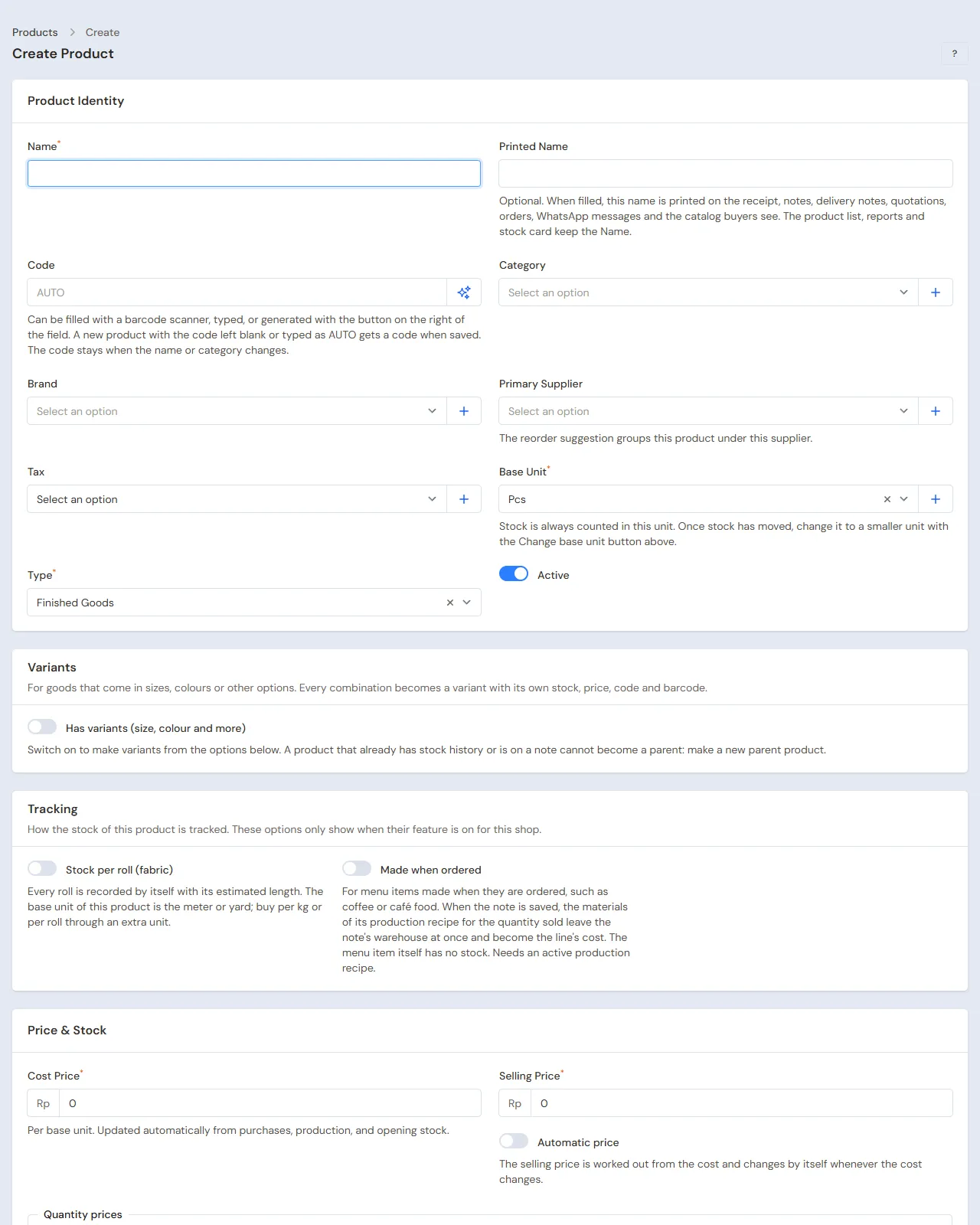
- In Master Data → Products, press New Product, fill in Name Katun Jepang, Category Cotton Fabrics, Base Unit Metre, Selling Price Rp 25.000.
- In the Other Units section, press Add Unit, choose Kilogram, fill in Contains (in base units) 4. It means the shop reckons 1 kg gives 4 metres.
- In the Tracking section, switch on Stock per roll (fabric).
- In the Quantity prices table under Selling Price, fill in From quantity 50 and its price Rp 22.000. See Quantity prices.
- Press Create.
Make Rayon Premium too (Synthetic Fabrics, Metre, unit Kilogram containing 5, Rp 18.000 per metre) and Kain Batik Cap Pekalongan (Batik Fabrics, Metre, unit Roll containing 50, Rp 45.000 per metre), both with Stock per roll (fabric).
What the kilogram contains is only a first estimate. Once some rolls are finished, Vende takes the average metres per kg of the finished rolls as the estimate of the next roll.
Sewing supplies
Store Head: make Benang Jahit 500 m (selling price Rp 7.000) and Resleting 20 cm (selling price Rp 2.500), category Sewing Supplies, Base Unit Pcs, without roll tracking.
The Store Head does not see Cost Price, because the cost of goods shows only to the Owner and holders of Sensitive Reports. Leave it: the purchase notes in part 3 fill in the cost of every fabric and sewing supply. See Cost price of goods.
Suppliers and customers
- Store Head: in Master Data → Suppliers, list PT Tekstil Makmur Bandung with Payment Terms (days) 30, and Grosir Aksesori Jahit Sentosa.
- Head Cashier: in Master Data → Customers, list Konveksi Maju Jaya with Payment Terms (days) 30, and Penjahit Bu Ratmi.
Regular customers who always get another price, for example every garment maker, can be gathered in one group with its own prices. See Special Prices for customers and groups.
3. Starting capital and buying fabric
-
The Owner records capital of Rp 15.000.000 into Bank BCA in Transactions → Finance → Owner's Capital.
-
The Store Head moves Rp 500.000 from Bank BCA to Cashier Cash as change money in Transactions → Finance → Cash Transfers.
-
The Store Head records the note of PT Tekstil Makmur Bandung in Transactions → Purchases, without a payment. Every roll is one line, in Kilogram:
- Katun Jepang 25 kg × Rp 40.000 = Rp 1.000.000, estimated at 100 m;
- Katun Jepang 24 kg × Rp 40.000 = Rp 960.000, estimated at 96 m;
- Rayon Premium 20 kg × Rp 28.000 = Rp 560.000, estimated at 100 m.
That is Rp 2.520.000, and the payable falls due in 30 days.
-
The Store Head records the note of Grosir Aksesori Jahit Sentosa, paid in full from Bank BCA: 100 Benang Jahit 500 m (Rp 450.000) and 200 Resleting 20 cm (Rp 240.000), so Rp 690.000.
Tap the fabric's name on the purchase line to open its details. Roll code stays empty so it fills in by itself (R-0001, R-0002 and so on). Estimated roll length comes from the kg times what the unit contains; type another length when the roll's label states it. Kain Batik Cap is bought per Roll with the length measured on unloading.
Once the note is saved, the three rolls show in Master Data → Fabric Rolls. The cost per metre of Katun Jepang is Rp 1.000.000 ÷ 100 m = Rp 10.000, and of Rayon Premium Rp 560.000 ÷ 100 m = Rp 5.600. See Recording a purchase note.
4. A day of selling
| Time | Who | Work |
|---|---|---|
| 08.00 | Cashier | Opens the till |
| All day | Cashier, Head Cashier | Cuts fabric and sells it per metre |
| When a roll runs out | Cashier | Presses Roll finished |
| Closing | Store Head | Counts the drawer and banks the money |
Selling fabric per metre
Open the till with New sale on the Dashboard. Type the metres on the fabric's line, a fraction with a comma, for example 3,5.
- Head Cashier (Lina): Konveksi Maju Jaya buys 60 m of Katun Jepang. Choose Konveksi Maju Jaya and type 60: the quantity price applies right away, 60 × Rp 22.000 = Rp 1.320.000. Under Roll being cut, choose R-0001. Press Pay, Unpaid, then Save transaction. The receivable falls due in 30 days.
- Cashier (Dewi): Penjahit Bu Ratmi buys 3,5 m of Katun Jepang (Rp 87.500), 2 Benang Jahit 500 m (Rp 14.000) and 5 Resleting 20 cm (Rp 12.500), so Rp 114.000 in cash. Roll being cut stays on the oldest roll, so R-0001 is cut.
- Cashier: a walk-in buyer buys 4 m of Rayon Premium, Rp 72.000, paid by QRIS into Bank BCA.
Afterwards R-0001 has 100 − 60 − 3,5 = 36,5 m left. See Recording sales on the till.
Cut fabric is usually not returned. Sewing supplies brought back are recorded with Add return from their original note. See Recording a sales return.
Fabric rolls and Roll finished
Master Data → Fabric Rolls lists every roll with its Estimated length and what is Left in stock. Left in stock is the estimate less what was sold, so it is seldom exactly zero when the roll is really used up.
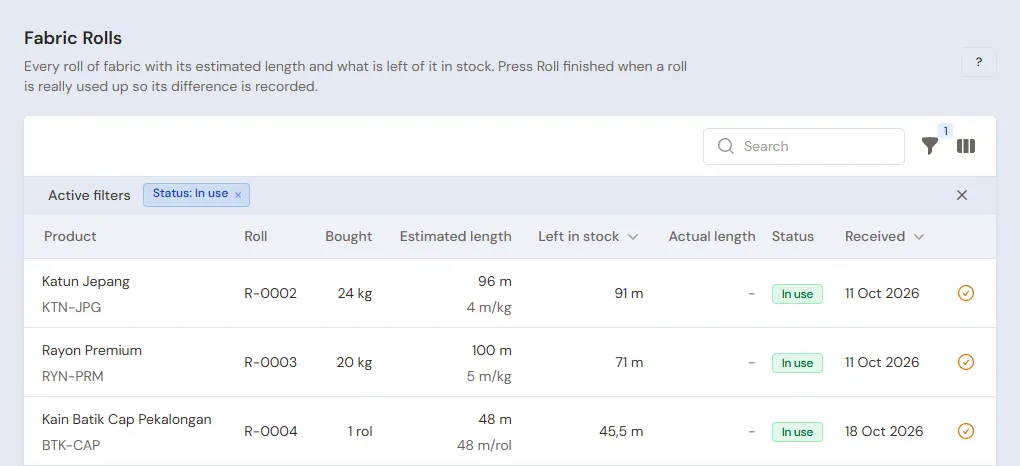
Cashier: when the last of a roll is cut, press the Roll finished icon (a check in a circle) on that roll's row in Master Data → Fabric Rolls. For example R-0001 after 98,5 m have gone:
- The stock still holds 1,5 m, but the roll is used up. Roll finished records the 1,5 m as a shortfall with a stock adjustment out at its cost, 1,5 × Rp 10.000 = Rp 15.000, category Stocktake difference.
- When a roll gives more than estimated, for example 101 m, what is left is minus 1 m and the extra is recorded with a stock adjustment in.
A finished roll cannot be sold any more. Pressed it by mistake? The Head Cashier presses Undo Roll finished on that roll's row.
Closing and banking the till cash
The Store Head (Hasan) counts the drawer: Rp 500.000 change money + Rp 114.000 = Rp 614.000. The Rp 114.000 is moved to Owner Cash in Transactions → Finance → Cash Transfers. The drawer holds less or more than counted? The Store Head records the difference in Transactions → Finance → Cash Adjustments. See Moving money between cash accounts.
5. Receivables, payables and costs
- The Store Head records the payment of Konveksi Maju Jaya in Transaction Details → Sale Payments: Rp 1.320.000 into Bank BCA. See Recording payments of unpaid notes.
- The Store Head pays PT Tekstil Makmur Bandung before the due date in Transaction Details → Purchase Payments: Rp 2.520.000. See Paying what you owe suppliers.
- The Store Head records rent, electricity, salaries and shopping bags in Transactions → Finance → Expenses. See Recording shop expenses.
6. Reports per job title
| Report | What it holds | Opened by | When |
|---|---|---|---|
| Master Data → Fabric Rolls | Every roll and what is left of it | Cashier | Every day |
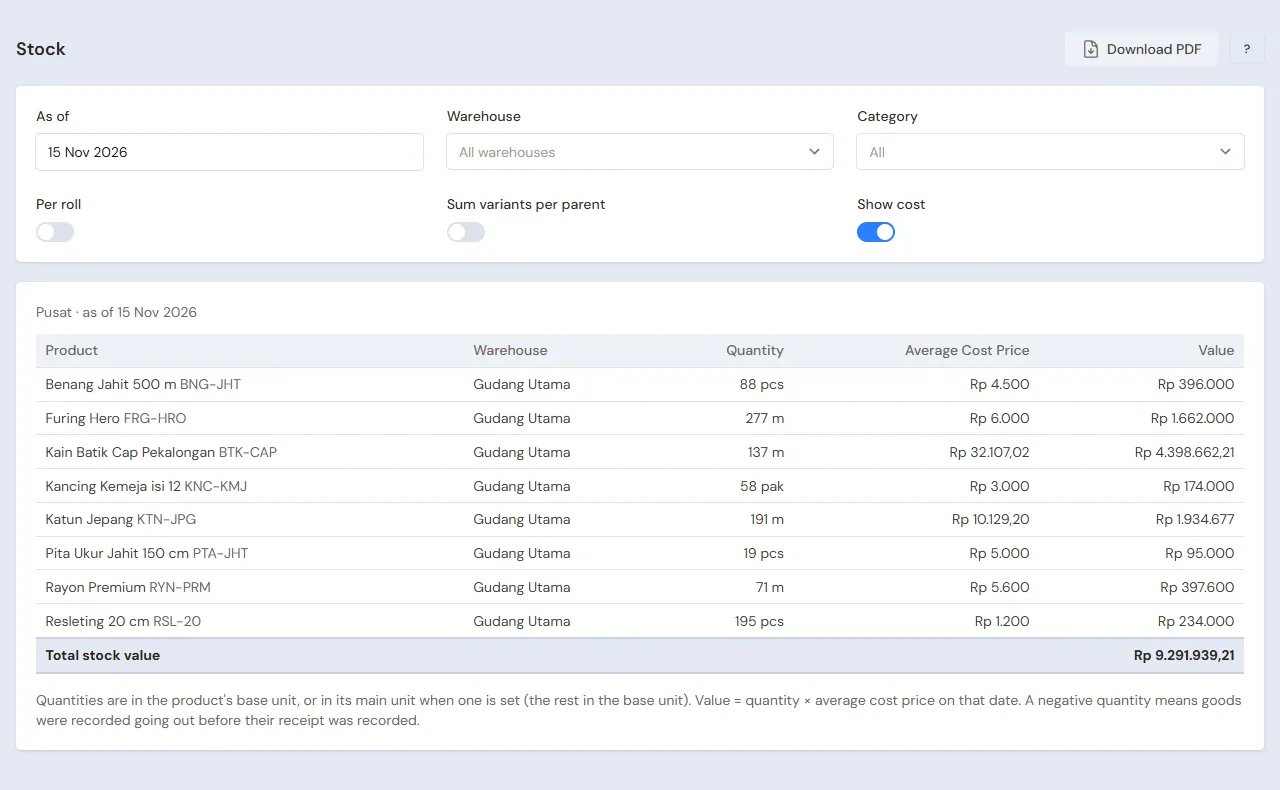
| Reports → Stock | The metres of every fabric; switch on Per roll for what is left of every roll | Store Head | Every day |
| Reports → Cash Balance | The drawer, Owner Cash and the bank | Store Head | Every day |
| Reports → Receivables | What every garment maker still owes | Store Head | Every week |
| Reports → Payables | What is owed to the textile mill and when | Store Head | Every week |
| Reports → Profit & Loss | Sales, cost of the fabric sold, roll shortfalls and gains, and expenses | Owner | Every month |
7. Checklists
- Every day: the Cashier chooses the roll being cut when there are several rolls of the same fabric, and presses Roll finished as soon as a roll runs out. The Store Head counts the drawer and banks the money.
- Every week: the Store Head collects from garment makers whose notes are due and pays the textile mill.
- Every month: the Store Head counts the sewing supplies with a stocktake and checks rolls that have not been cut for a long time. The Owner reads Profit & Loss. See Counting stock with a stocktake.
A running business
This part is for the team moving a running fabric shop to Vende: whole and cut rolls on the shelves, garment makers who still owe money, and payables to the textile mill. The order is always the same:
- Enter the master data.
- Practise transactions until every part is used to them.
- Empty the practice transactions.
- Enter the opening balances on the first day.
- Go live.
The opening balances come last on purpose, so the practice does not spoil their figures. The examples in this part use Toko Kain Sejahtera from the new business part.
1. Master data
Work through the parts Who does what, 1. Shop details and users and 2. Master data above. Also list every fabric that still has rolls, every garment maker who still owes money, and every supplier still owed. The master data is not deleted when the practice transactions are emptied.
2. Practice for the team
Work in a practice shop of the Fabric shop type with the four accounts. Every step names who does it and what must show.
Practice 1: master data
- Owner: the shop details, the three users and the receipt.
- Store Head: the three fabrics with their units and roll tracking, the quantity price of Katun Jepang, the sewing supplies and both suppliers.
- Check: Katun Jepang shows Kilogram containing 4 and Stock per roll (fabric) switched on.
- Head Cashier: Konveksi Maju Jaya and Penjahit Bu Ratmi.
Practice 2: a day of selling
- Owner: capital of Rp 15.000.000 into Bank BCA.
- Store Head: the transfer of Rp 500.000 to Cashier Cash and both purchase notes as in part 3.
- Check: Master Data → Fabric Rolls holds R-0001 100 m, R-0002 96 m and R-0003 100 m. Opened by the Store Head.
- The Head Cashier and Dewi (Cashier): the three sales as in part 4.
- Check: in Master Data → Fabric Rolls, R-0001 has 36,5 m left. Opened by the Cashier.
- Store Head: the transfer of Rp 114.000 from Cashier Cash to Owner Cash.
After Practice 2 this must show:
| Report | What must show | Opened by |
|---|---|---|
| Reports → Cash Balance | Cashier Cash Rp 500.000; Owner Cash Rp 114.000; Bank BCA Rp 15.000.000 − Rp 500.000 − Rp 690.000 + Rp 72.000 = Rp 13.882.000 | Store Head |
| Reports → Receivables | Konveksi Maju Jaya Rp 1.320.000 | Store Head |
| Reports → Payables | PT Tekstil Makmur Bandung Rp 2.520.000 | Store Head |
| Reports → Stock | Katun Jepang 196 − 63,5 = 132,5 m, Rayon Premium 96 m, Benang Jahit 500 m 98, Resleting 20 cm 195 | Store Head |
| Reports → Profit & Loss | Net sales Rp 1.320.000 + Rp 114.000 + Rp 72.000 = Rp 1.506.000, cost of goods sold Rp 672.400 | Owner |
Cost of goods sold: Katun Jepang 63,5 m × Rp 10.000 = Rp 635.000, Rayon Premium 4 m × Rp 5.600 = Rp 22.400, thread Rp 9.000 and zips Rp 6.000.
Practice 3: opening balances
Enter the opening balances with the example of part 4 below, check them as in part 5, then empty them again.
3. Emptying the practice transactions
Done by the Owner in Settings → Empty Transactions, button Empty All Transactions. Sale notes, purchases, fabric rolls, stock adjustments (those of Roll finished included), payments, cash transfers, capital, expenses and opening balances are deleted. Products with their units and quantity prices, customers, suppliers, cash accounts, users and settings stay. Vende makes a full backup first. See Emptying transactions or all data.
4. Opening balances
Done by the Owner in Settings → Opening Balances on the morning of the first day, with As of that day, before the shop opens. See Entering opening cash, stock, receivables and payables.
One opening stock row per roll
The Opening Stock tab has no roll length field. So every roll on the shelf is entered as a row of its own, and its length comes from the quantity and the unit:
- A cut roll: Unit Metre, Quantity the length left, Cost Price per Unit per metre. For example Katun Jepang 36,5 Metres at Rp 10.000.
- A whole roll: Unit Kilogram, Quantity the weight on its label, Cost Price per Unit per kg. For example Katun Jepang 25 Kilograms at Rp 40.000, which becomes a 100 m roll.
Leave Batch number empty so the roll code is automatic, or type the code stuck on the roll. Enter the cut rolls first: the roll entered first is cut first when the cashier does not choose one. After the two rows above, Master Data → Fabric Rolls holds R-0001 36,5 m and R-0002 100 m, and the stock of Katun Jepang is 136,5 m worth Rp 365.000 + Rp 1.000.000 = Rp 1.365.000.
What is left of a cut roll is only an estimate. When that roll runs out after only 36 m have been cut, Roll finished records the 0,5 m that is no longer there as a shortfall of Rp 5.000.
Receivables, payables and cash
- Opening Receivables: Konveksi Maju Jaya Rp 800.000 with its due date.
- Opening Payables: PT Tekstil Makmur Bandung Rp 1.200.000.
- Opening Cash: the money counted in every account, for example Cashier Cash Rp 500.000 and Bank BCA Rp 9.000.000.
Sewing supplies go into Opening Stock like any item, for example Benang Jahit 500 m 60 Pcs at Rp 4.500.
5. Check before going live
| Report | What must show | Opened by |
|---|---|---|
| Reports → Cash Balance | The money counted in every account | Store Head |
| Master Data → Fabric Rolls | One row for every roll on the shelf, for example R-0001 36,5 m and R-0002 100 m | Store Head |
| Reports → Stock | Katun Jepang 136,5 m, Benang Jahit 500 m 60 | Store Head |
| Reports → Receivables | Konveksi Maju Jaya Rp 800.000 | Store Head |
| Reports → Payables | PT Tekstil Makmur Bandung Rp 1.200.000 | Store Head |
The figures differ? The Owner corrects the row in Settings → Opening Balances before any real transaction is recorded.
6. Going live
From that day every sale, purchase of new rolls, Roll finished and payment is recorded in Vende as in the new business part, with the same checklist. In the first week the Cashier presses Roll finished for every old roll that runs out, the Store Head matches Reports → Stock with the shelves, and the Owner checks that Reports → Profit & Loss only holds sales and costs since the first day.