
Coworking and meeting room guide
A learning path for a coworking space, new or running: desks by the hour and day, a meeting room with bookings, monthly members, opening balances.
On this page
- A new business
- Who does what
- 1. Shop details and users
- 2. Master data
- 3. Starting capital and the first purchases
- 4. One day at the coworking space
- 5. Receivables, payables and expenses
- 6. Reports per job title
- 7. Checklist
- A running business
- 1. Master data
- 2. Team practice
- 3. Empty the practice transactions
- 4. Opening balances
- 5. Check before going live
- 6. Going live
This guide is for the team setting up Vende at a coworking space that rents out desks by the hour or by the day, a meeting room with bookings, and monthly memberships, and sells coffee and printing. It has two parts: A new business for a space just opening, with no stock, receivables or payables from before, and A running business for one moving to Vende, with team practice and opening balances. The example is Ruang Kerja Teras. The names of the business, customers, suppliers and people and all the figures are made up.
What the business looks like:
- Desks: six desks at Rp 15.000 an hour, Paket Setengah Hari (half-day package) of 4 hours Rp 45.000, and Paket Harian (day package) of 8 hours Rp 75.000.
- Meeting room: one room at Rp 100.000 an hour and Paket 4 Jam Meeting (4-hour meeting package) Rp 350.000, booked by companies with a down payment and the rest billed.
- Monthly members: Rp 750.000 a month, free use of the members' desks, billed every month on the day they joined.
- Selling: ready-to-drink coffee with milk and lemon tea, filled bread, and black and white A4 printing.
Work through it from the top. Every step names its menu, who does it, what changes afterwards, and an example with figures.
The features in this guide come with the Coworking/meeting rooms business type package, except those marked extra. The shop's features show under Settings → Subscription, section This shop's features. If a menu is missing, contact the Vende team.
Tip: Lost on a page? Press the ? button at the top of that page. A short tour shows every field, on the Rental Board too.
A new business
Who does what
This package holds three users, the owner included.
| Part of the coworking space | Job title in Vende | What they do and open |
|---|---|---|
| Owner | Owner | Every menu: desks and rooms with their rates, products and services, purchases, stock, opening balances and every report |
| Front desk | Head Cashier | The Rental Board, bookings and down payments, members and their subscriptions, members' draft bills, the till |
| Finance | Finance Admin | Company receivables and their payments, money owed to suppliers, expenses, Reports → Cash Balance |
Every role is explained in Roles and permissions.
1. Shop details and users
Done by the Owner: fill in Settings → Shop (name, address, WhatsApp, logo), then create the accounts in Settings → Users with the Job title of the table above. See Adding and managing users.
The people at Ruang Kerja Teras: Mbak Sinta (owner), Galih (front desk, Head Cashier) and Rina (finance, Finance Admin).
2. Master data
A shop of this business type already has the product categories Venue Rental, Coffee, Non-Coffee Drinks, Snacks and Office Supplies, the units Cup, Portion and Sheet, and the expense categories Internet and Phone Credit and Equipment Maintenance.
Desks and the meeting room
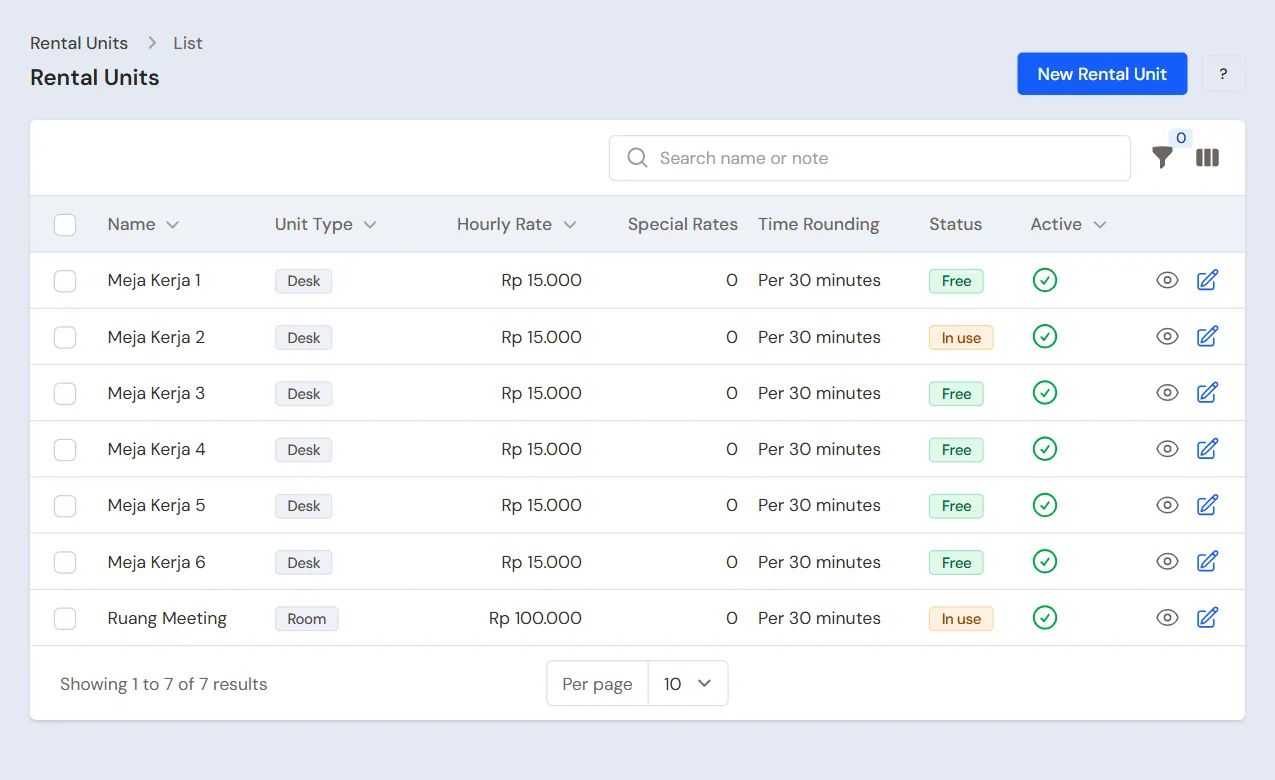
Owner: in Master Data → Rental Units, press New Rental Unit for every desk and room. Time Rounding Per 30 minutes, Minimum Charge 60 minutes, and Service on the Note left empty, so Vende uses the services Desk Rental and Room Rental and the money is booked to Rental Revenue.
| Name | Unit Type | Hourly Rate | Price Packages |
|---|---|---|---|
| Meja Kerja 1 to Meja Kerja 6 (desks) | Desk | Rp 15.000 | Paket Setengah Hari, 4 h, Rp 45.000; Paket Harian, 8 h, Rp 75.000 |
| Ruang Meeting (meeting room) | Room | Rp 100.000 | Paket 4 Jam Meeting, 4 h, Rp 350.000 |
The members' desks are not made rental units: members use them without a timer. A cheaper package applies by itself even when it was not picked: a guest who uses a desk for 7 hours is billed Paket Harian Rp 75.000, not 7 × Rp 15.000 = Rp 105.000.
The monthly membership and printing
Owner: in Master Data → Services, press New Service:
- Name Member Bulanan Hot Desk (monthly hot desk member), Price Rp 750.000, Default subscription length 1. Its value is recorded as Service Revenue month by month. Press Create.
- Name Cetak Hitam Putih A4 (black and white A4 print), Price Rp 1.000. Under Materials used, press Add material, pick Kertas A4 with a Quantity per service of 1. Press Create.
See Adding a service and Billing customer subscriptions automatically.
Drinks, bread and paper
Owner: in Master Data → Products, create:
| Item | Type | Category | Base Unit | Cost Price | Selling Price |
|---|---|---|---|---|---|
| Kopi Susu Cup (coffee with milk) | Finished Goods | Coffee | Cup | Rp 9.000 | Rp 15.000 |
| Teh Lemon Cup (lemon tea) | Finished Goods | Non-Coffee Drinks | Cup | Rp 6.000 | Rp 12.000 |
| Roti Isi (filled bread) | Finished Goods | Snacks | Pieces | Rp 7.000 | Rp 12.000 |
| Kertas A4 (A4 paper) | Raw Material | Office Supplies | Sheet | Rp 100 |
The coffee and lemon tea are bought ready to drink from a roastery every morning, so every cup sold takes its own stock down. Kertas A4 is a Raw Material, so it does not show at the till; it is only used by the printing service. See Adding a product.
Customers and suppliers
- Head Cashier: in Master Data → Customers, list CV Arunika Kreatif with Payment Terms (days) 14, and every member, for example Bu Laras. See Adding and changing customers.
- Owner: in Master Data → Suppliers, list Roastery Kopi Lereng with Payment Terms (days) 7, and Toko Kertas Sinar without terms. See Adding a supplier.
- Owner: in Master Data → Cash Accounts, use Cashier Cash for the front desk drawer and Bank BCA for QRIS and transfers. A new cash account shows on the Rental Board and the till only when its branch is ticked in Branches Allowed. See Cash accounts and bank accounts.
3. Starting capital and the first purchases
- The Owner records capital of Rp 10.000.000 into Bank BCA in Transactions → Finance → Owner's Capital. See Putting in and taking out capital.
- The Owner records Roastery Kopi Lereng's note in Transactions → Purchases, 7 days' terms: 20 Kopi Susu Cup × Rp 9.000 = Rp 180.000, 10 Teh Lemon Cup × Rp 6.000 = Rp 60.000 and 10 Roti Isi × Rp 7.000 = Rp 70.000. The total is Rp 310.000. See Recording a purchase note.
- The Owner records Toko Kertas Sinar's note, paid from Bank BCA: 500 Sheets of Kertas A4 × Rp 100 = Rp 50.000.
- The Owner moves Rp 300.000 of change from Bank BCA to Cashier Cash in Transactions → Finance → Cash Transfers.
4. One day at the coworking space
This example happens on the 1st to the 15th of the month. The reason is in A new member.
| Time | Work | Who |
|---|---|---|
| Morning | Meeting room booking, a new member | Head Cashier |
| All day | Desks by the hour and by the day, coffee, printing | Head Cashier |
| Midday | The meeting ends, the rest is billed | Head Cashier |
| Afternoon | The drawer and company receivables | Finance Admin |
Booking the meeting room
At 07.30, CV Arunika Kreatif books Ruang Meeting at 09.00 with Paket 4 Jam Meeting, then transfers a down payment of Rp 100.000 to Bank BCA.
- Head Cashier (Galih): in Transactions → Rental Bookings, press Schedule, then tap 09.00 in the row of Ruang Meeting.
- Pick the Price Package Paket 4 Jam Meeting. The Length follows the package. Pick the Customer CV Arunika Kreatif, then press Create.
- On the booking's page, press Receive Down Payment, pick Bank BCA, fill in Rp 100.000, then save.
The down payment waits as a customer advance, not income. The order holding it is listed in Transactions → Sales Orders.
A new member
At 08.00 Bu Laras joins as a monthly member.
- The Head Cashier opens the till with New sale on the Dashboard or in Transactions → Sales, picks Bu Laras in the Customer field, then adds Member Bulanan Hot Desk. The line is marked 1-month subscription. Bu Laras pays Rp 750.000 by transfer to Bank BCA.
- Head Cashier: in Transactions → Customer Subscriptions, press New Customer Subscription. In From sale note, pick the line of that note: the Customer and the Subscription service fill in by themselves.
- Fill in the Billing period 1, Subscribed since today, and Next period starts the same date next month. Leave the Status on Active, then press Create.
Three days before the next period, Vende writes a draft note of Rp 750.000 for Bu Laras, and the Head Cashier gets a note in the bell. That draft is paid at the till like any note. See Vende writes the draft bill.
Important: A fee sold on the 1st to the 15th starts being recognised as Service Revenue that month. One sold on the 16th or later only starts the next month, and until then it waits as Unearned Revenue. The cash still goes up on the day it is paid.
A member's arrival is not recorded on the Rental Board. Member check-in is an extra feature. If its menu is missing, contact the Vende team to switch it on.
A day guest
- At 08.30 Nadia comes for the day. Head Cashier: in Transactions → Rental Board, tap Meja Kerja 1, pick the Price packages Paket Harian, leave the Customer empty, then press Start.
- Nadia buys 2 Kopi Susu Cup. Open the session, then tap the coffee under Food and drinks.
- At 16.00 Nadia leaves. Press Finish & Pay: the package Rp 75.000 and coffee 2 × Rp 15.000 = Rp 30.000, so Rp 105.000, paid by QRIS into Bank BCA.
The meeting from the booking
- At 09.00 the CV Arunika Kreatif team arrives. The Head Cashier taps Ruang Meeting, then presses Start the booking. The package and the down payment come along.
- They order 6 Kopi Susu Cup.
- At 13.00 the meeting ends. Press Finish & Pay: the package Rp 350.000 and coffee 6 × Rp 15.000 = Rp 90.000, so Rp 440.000. The down payment of Rp 100.000 is deducted, so To pay is Rp 340.000.
- CV Arunika Kreatif pays by transfer after the bill, so the Amount received is 0. The shortfall stays on CV Arunika Kreatif's account, due in 14 days.
A booking the company cancels is cancelled by the Head Cashier with Cancel Booking on its page: its down payment is refunded or forfeited and booked to Other Income.
A desk by the hour and printing
At 13.00 Bima uses Meja Kerja 2 without a package, then prints 10 sheets. At 15.00 the Head Cashier presses Finish & Pay: 2 hours × Rp 15.000 = Rp 30.000 and Cetak Hitam Putih A4 10 × Rp 1.000 = Rp 10.000, so Rp 40.000 in cash. Every sheet printed takes one sheet of Kertas A4 down.
The drawer
The Finance Admin (Rina) opens Reports → Cash Balance: Cashier Cash Rp 300.000 + Rp 40.000 = Rp 340.000, the same as the money in the drawer. Rina banks Rp 40.000 into Bank BCA with Transactions → Finance → Cash Transfers.
5. Receivables, payables and expenses
- The Finance Admin records CV Arunika Kreatif's transfer in Transaction Details → Sale Payments and checks what is overdue in Reports → Receivables. See Recording payment of an unpaid note.
- The Finance Admin pays Roastery Kopi Lereng before the due date in Transaction Details → Purchase Payments. See Paying what you owe suppliers.
- The Finance Admin records the internet in Transactions → Finance → Expenses, category Internet and Phone Credit, and printer repairs in the category Equipment Maintenance. See Recording shop expenses.
The day's profit: desks and room Rp 75.000 + Rp 350.000 + Rp 30.000 go on the line Rental Revenue Rp 455.000, the member fee Rp 750.000 and printing Rp 10.000 on Service Revenue Rp 760.000, and the coffee Rp 30.000 + Rp 90.000 on Sales of Goods Rp 120.000, so Net sales is Rp 1.335.000. The cost of goods sold is Rp 73.000 (coffee 8 × Rp 9.000 and paper 10 × Rp 100), so the gross profit is Rp 1.262.000.
6. Reports per job title
| Report | What it holds | Opened by | When |
|---|---|---|---|
| Transactions → Rental Bookings | The schedule of the meeting room and desks, bookings and their down payments | Head Cashier | Every morning |
| Transactions → Customer Subscriptions | The active members and their next period | Head Cashier | Every week |
| Reports → Cash Balance | The money in the drawer and the bank | Finance Admin | Every afternoon |
| Reports → Receivables | Company and member bills not paid yet | Finance Admin | Every week |
| Reports → Stock | The coffee, bread and paper left | Owner | Every morning before buying |
| Reports → Profit & Loss | Rental Revenue, Service Revenue, Sales of Goods, cost of goods sold and expenses | Owner | Every month |
7. Checklist
- Every day: the Head Cashier starts every desk and room on the Rental Board, records every coffee and print in its session, records every booking with its down payment, and takes payment of the members' draft bills due that day. The Finance Admin checks the drawer.
- Every week: the Finance Admin reads Receivables and Payables. The Head Cashier checks Customer Subscriptions: a member who leaves has the Status changed to Stopped.
- Every month: the Owner does a stocktake of paper and reads the Profit & Loss. The Finance Admin records the internet, electricity and building rent.
A running business
This part is for the team moving a running coworking space to Vende: there are members who have paid this month or not, meeting room bookings already paid a down payment, companies that have not paid, and money owed to the roastery. The order is always the same:
- Fill in the master data.
- Practise transactions until every part is used to them.
- Empty the practice transactions.
- Fill in the opening balances on the first day.
- Go live.
The opening balances come last on purpose, so the practice does not mess up their figures. The examples in this part use Ruang Kerja Teras from the new business part, with 2 November as the first day.
1. Master data
Do the parts Who does what, 1. Shop details and users and 2. Master data above: the desks and the room with their packages, the membership and printing services, the goods, customers and suppliers. List also every member and every company that still owes. Master data is not deleted when the practice transactions are emptied.
2. Team practice
Work in a practice shop of the type Coworking/meeting rooms with all three accounts.
Practice 1: master data
- Owner: the shop details, both users, the six desks and Ruang Meeting with their packages, both services, the four goods and both suppliers.
- Check: Kertas A4 does not show at the till, and the Rental Board shows seven units.
- Head Cashier: CV Arunika Kreatif and Bu Laras.
Practice 2: one day at the coworking space
- Owner: capital Rp 10.000.000, both purchase notes and the Cash Transfer of Rp 300.000.
- Head Cashier: the Ruang Meeting booking with a down payment of Rp 100.000 into Bank BCA, Bu Laras's fee of Rp 750.000 with her subscription, Meja Kerja 1 for Nadia Rp 105.000 by QRIS, Ruang Meeting from the booking with the rest of Rp 340.000 not paid, and Meja Kerja 2 for Bima Rp 40.000 in cash.
- When the practice does not run at the same hours, use other hours: what matters is how long the desk or room is used.
- Finance Admin: the Cash Transfer of Rp 40.000 to Bank BCA.
After Practice 2 you should see:
| Report | What you should see | Opened by |
|---|---|---|
| Reports → Cash Balance | Bank BCA Rp 10.000.000 − Rp 50.000 − Rp 300.000 + Rp 100.000 + Rp 750.000 + Rp 105.000 + Rp 40.000 = Rp 10.645.000, Cashier Cash Rp 300.000 | Finance Admin |
| Reports → Receivables | CV Arunika Kreatif Rp 340.000 | Finance Admin |
| Reports → Payables | Roastery Kopi Lereng Rp 310.000 | Finance Admin |
| Reports → Stock | Coffee 12 cups, lemon tea 10 cups, filled bread 10, paper 490 sheets | Owner |
| Transactions → Customer Subscriptions | Bu Laras, Active, next period next month | Head Cashier |
| Reports → Profit & Loss | Sales of Goods Rp 120.000, Service Revenue Rp 760.000, Rental Revenue Rp 455.000 (Net sales Rp 1.335.000) and Cost of Goods Sold Rp 73.000 | Owner |
Practice on the 16th or later: Bu Laras's fee is not in Service Revenue yet, so Service Revenue is Rp 10.000 and Net sales Rp 585.000.
Practice 3: opening balances
Fill in the opening balances with the example of part 4 below, including the members and the booking with a down payment, check them as in part 5, then empty again.
3. Empty the practice transactions
Done by the Owner in Settings → Empty Transactions, button Empty All Transactions. Notes and drafts, rental sessions, bookings and their down payment orders, purchases, payments, cash transfers, capital and opening balances are deleted. The desks and the room with their packages, services, goods, customers, suppliers, cash accounts, users and settings stay. Customer Subscriptions stay too, because they are master data: delete the practice subscriptions in Transactions → Customer Subscriptions, or put their dates right in step 4. Vende makes a full backup first. See Emptying transactions or all data.
4. Opening balances
The Owner fills in Settings → Opening Balances on the morning of the first day, with As of that day. See Entering opening cash, stock, receivables and payables.
- Opening Stock: the goods counted, for example 10 Roti Isi at Rp 7.000 and 300 Sheets of Kertas A4 at Rp 100. The coffee and tea are bought that morning as usual.
- Opening Receivables: one row per bill not paid yet: CV Arunika Kreatif Rp 500.000, and Pak Dimas's October fee Rp 750.000.
- Opening Payables: Roastery Kopi Lereng Rp 200.000 with its due date.
- Opening Cash: Cashier Cash Rp 300.000, then Bank BCA as below.
Monthly members
Opening Balances has no members tab. The Head Cashier registers every member in Transactions → Customer Subscriptions on the first day, without From sale note: the Customer, the Subscription service Member Bulanan Hot Desk, the Billing period 1, Subscribed since the date they joined, and Next period starts the first period they have not paid. A member whose fee is not Rp 750.000, for example an old price: fill in the Price per period with that fee.
| Member | Joined | Paid | Next period starts | What happens |
|---|---|---|---|---|
| Bu Laras | 5 September | Up to 4 November | 5 November | A draft note for the period of 5 November, because three days before falls on the first day |
| Pak Dimas | 1 August | Up to 30 September | 1 November | A draft note for November. The October fee is already in Opening Receivables |
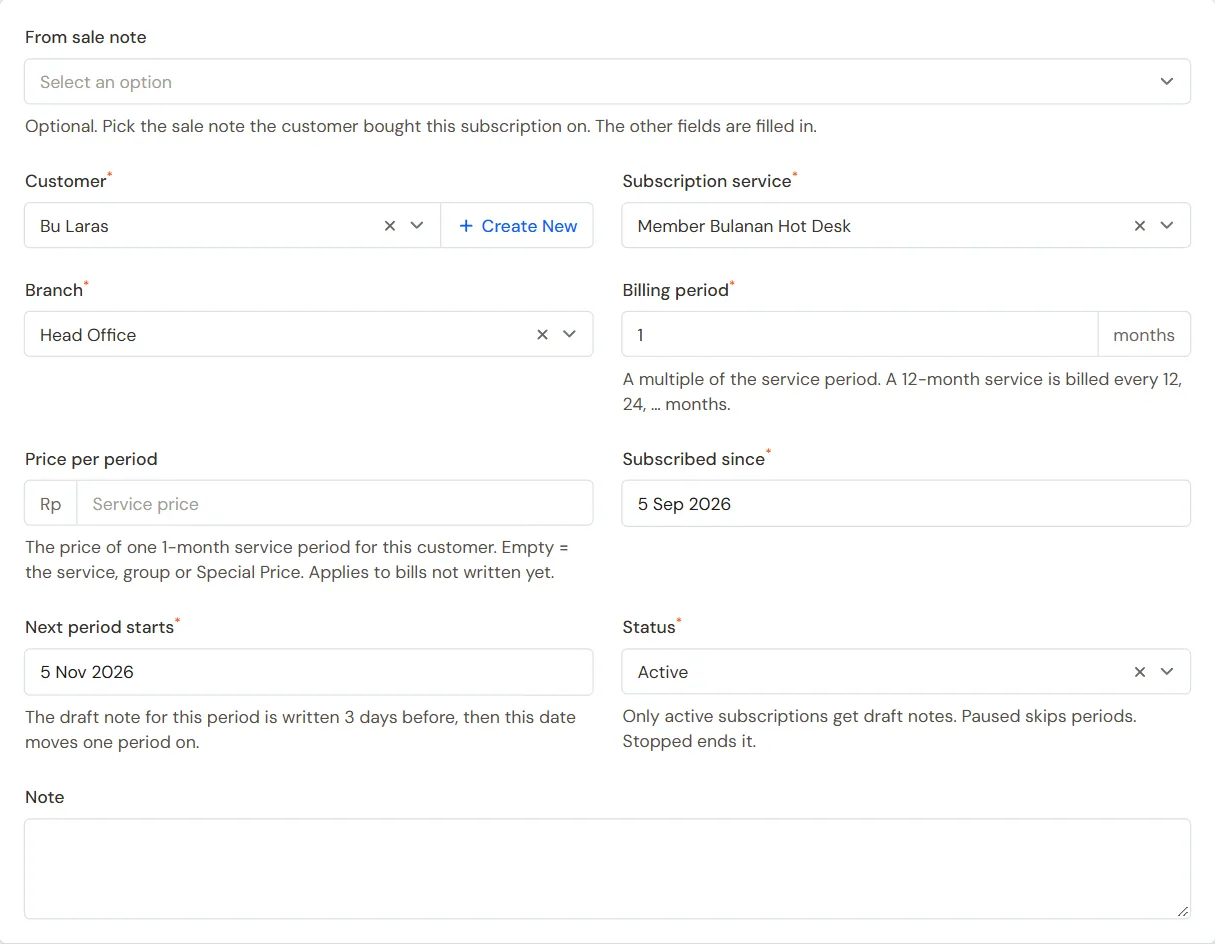
Vende writes the draft bills every night, so both drafts are in Transactions → Sales, tab Draft, the next morning, and the Next period starts of both moves one month on.
- A fee paid before the first day is already in the money counted for the opening cash. It is not recorded again and does not show in the Profit & Loss.
- Next period starts is at the earliest the start of this month. An unpaid period of an earlier month goes in as Opening Receivables, like Pak Dimas's October fee.
- A draft note only changes the cash and the Profit & Loss when it is paid at the till. Pak Dimas paying the November draft in November adds Rp 750.000 of Service Revenue that month.
Bookings already paid a down payment
Opening Balances has no bookings tab. A booking whose down payment came in before the first day is written again on the first day:
- Owner: the Opening Cash of Bank BCA = the bank balance − the down payments of bookings still to come. For example: the balance is Rp 9.000.000, including the down payment of Rp 100.000 of CV Arunika Kreatif for Ruang Meeting on Thursday at 09.00, so the opening cash is Rp 8.900.000.
- Head Cashier: in Transactions → Rental Bookings, create that booking: Ruang Meeting, Thursday at 09.00, Price Package Paket 4 Jam Meeting, Customer CV Arunika Kreatif.
- Head Cashier: on the booking's page, press Receive Down Payment, pick Bank BCA and fill in Rp 100.000. Bank BCA is back at Rp 9.000.000, the same as the bank balance.
5. Check before going live
| Report | What you should see | Opened by |
|---|---|---|
| Reports → Cash Balance | Cashier Cash Rp 300.000 and Bank BCA Rp 9.000.000 | Finance Admin |
| Reports → Receivables | CV Arunika Kreatif Rp 500.000 and Pak Dimas Rp 750.000 | Finance Admin |
| Reports → Payables | Roastery Kopi Lereng Rp 200.000 | Finance Admin |
| Reports → Stock | Filled bread 10, paper 300 sheets | Owner |
| Transactions → Customer Subscriptions | Bu Laras, Active, next period 5 November, and Pak Dimas, Active, 1 November | Head Cashier |
| Transactions → Rental Bookings | The booking of CV Arunika Kreatif on Ruang Meeting, Booked, Down Payment Rp 100.000 | Head Cashier |
The figures differ? The Owner corrects the row in Settings → Opening Balances before any real transaction is recorded.
6. Going live
From that day every desk, room, booking, member fee and purchase is recorded in Vende as in the new business part, with the same checklist. In the first week, the Head Cashier matches Transactions → Customer Subscriptions with the old member list, and the Finance Admin matches Reports → Receivables with the unpaid bills.